In this guide
- Match the product and batch first
- Read the scope, not just the heading
- A practical document checklist
- Keep the conclusion within the evidence
- Think of traceability as a chain of references
- Separate a result from an interpretation
- A practical route from a product page
- What a document does not establish by itself
A downloadable document can make a product page feel reassuring. Its real value comes from the details inside it. Before relying on a record, establish whether it refers to the material you are looking at and what it actually reports.
Match the product and batch first
Look for the product identifier and batch or lot reference. Compare them with the listing and, where relevant, the packaging. A matching product name alone is not enough to establish that a document covers the particular batch in front of you.
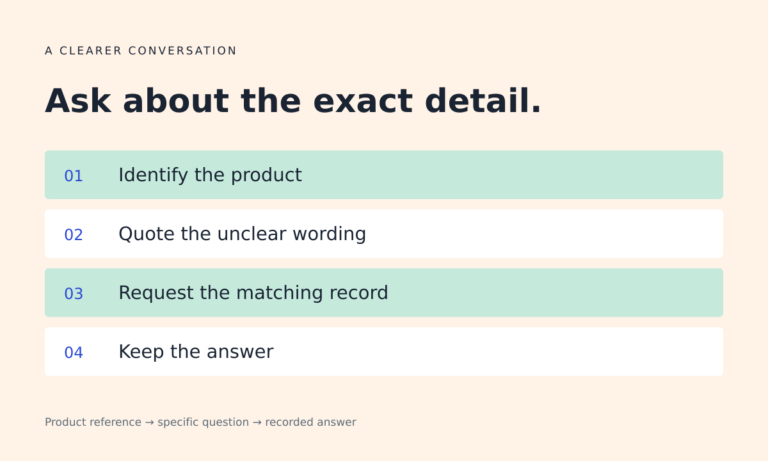
If the listing does not identify the batch, ask which record applies. Save the answer with the document so that the connection remains clear later. Avoid filling in missing information from a different product page.
Read the scope, not just the heading
“Certificate of analysis” is a document title, not a substitute for reading the reported properties. As a useful example of detailed documentation, NIST describes its own Standard Reference Material certificates as identifying the material and intended purpose, methods, certified values and associated uncertainty, alongside other relevant information. These are NIST’s certificates for its reference materials; an ordinary supplier report should not be assumed to have the same status. Reference: NIST SRM definitions.
For a supplier document, write down the property reported, the result, the units and the stated method. If a percentage appears, ask what that percentage measures. Do not silently turn one reported result into a claim about every property of the material.
A practical document checklist
- Does the product identifier match the item being reviewed?
- Is there a batch or lot number, and can it be matched?
- Who issued the document, and is a report date shown?
- Which properties and methods are actually listed?
- Are units, qualifications or limitations explained?
- Is there a way to query an unclear or missing detail?
These are reading prompts, not a certification process. If an essential answer is missing, record it as missing and request clarification. A neat layout or a familiar logo does not resolve an information gap.
Keep the conclusion within the evidence
A record should be interpreted within its stated scope. It should not be presented as proof of human-use safety or a treatment benefit. Likewise, linking to NIST here does not mean that NIST has tested, certified or endorsed products in our catalogue.
Think of traceability as a chain of references
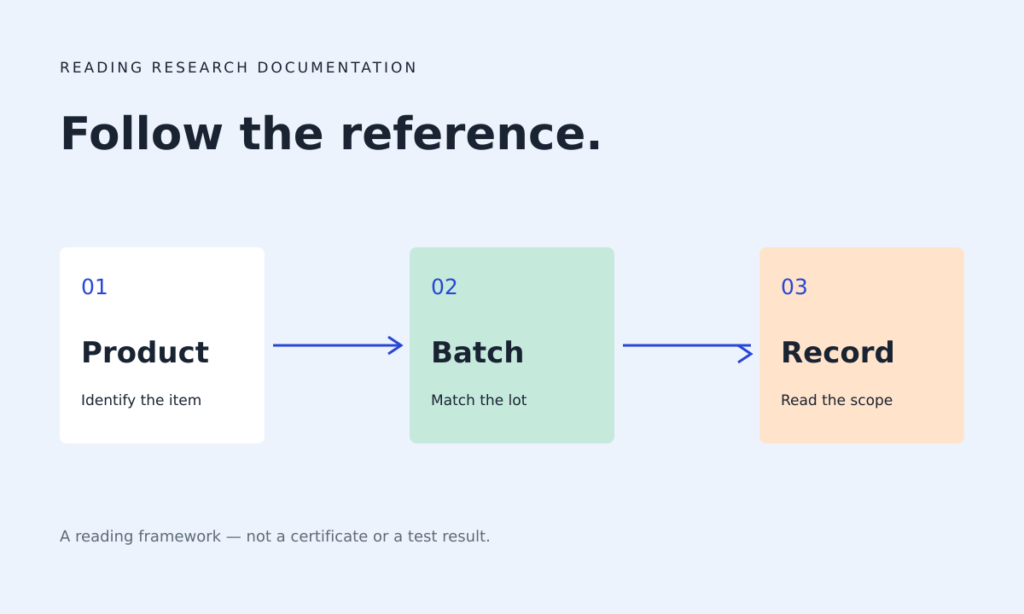
A useful record should let you follow a path from the item to the information about it. Start with the product name, identify the batch or lot, then identify the document that applies. If one of those links is missing, a result elsewhere on the page does not fill the gap.
For example, suppose a listing refers to a hypothetical lot “AB-01”, while a downloadable report identifies “AB-02”. The similar numbering does not make the documents interchangeable. Your next question is which document applies to AB-01. This example illustrates a reading check; it is not a description of any batch in our catalogue.
Keep the exact characters in a reference, including punctuation or suffixes. When sending a question, quoting the identifier is more reliable than describing it as “the recent batch” or “the blue box”.
Separate a result from an interpretation
A report can contain a value, a unit, a method and a statement about the sample. Read those as a set. Copying only the largest percentage can remove the context needed to understand what was measured.
Use a simple note with four fields: “reported property”, “reported value and unit”, “method or reference”, and “question still open”. If you cannot fill a field from the document, leave it blank and ask. This helps you distinguish what the document says from what you would like it to establish.
Do not turn the absence of a reported measurement into a negative result. “Not shown in this document” and “tested and not detected” are different statements. Equally, a document describing one property should not be summarised as a universal guarantee about the product.
A practical route from a product page
Take a real listing, such as GHK-Cu Copper Peptide, and start with the exact product identity. If relevant batch documentation is available, match it before reading the results. If the applicable document is not provided, use the contact page to request clarification. The presence of this example link does not assert that a particular certificate is available or that a particular testing result has been verified.
When a supplier sends a record, save the file together with the date received and the message identifying the batch. If a revised document arrives later, retain a clear version trail rather than silently replacing your notes. That makes it easier to understand which information informed an earlier decision.
What a document does not establish by itself
A professional-looking report does not establish that it covers your item. A supplier’s logo does not establish independent testing. A statement about a sample does not, without the appropriate context, establish every property of every container. These are reasons to read carefully, not reasons to make an accusation when a detail is missing.
Ask the issuing party or supplier to explain an unclear claim. If you need technical interpretation beyond the document’s plain wording, obtain appropriate expertise for your research context rather than relying on a shopping page to settle the question.
Is a certificate the same as approval for human use?
No such conclusion should be drawn from a research-product certificate. Our catalogue is not sold for human or animal consumption, diagnosis or treatment. Keep that intended-use limit separate from the properties a document reports.
What should I do when the batch is not shown online?
Ask which batch would apply and which supporting record corresponds to it. Keep the answer alongside the document. Do not assume that a record for a similarly named product is a match.